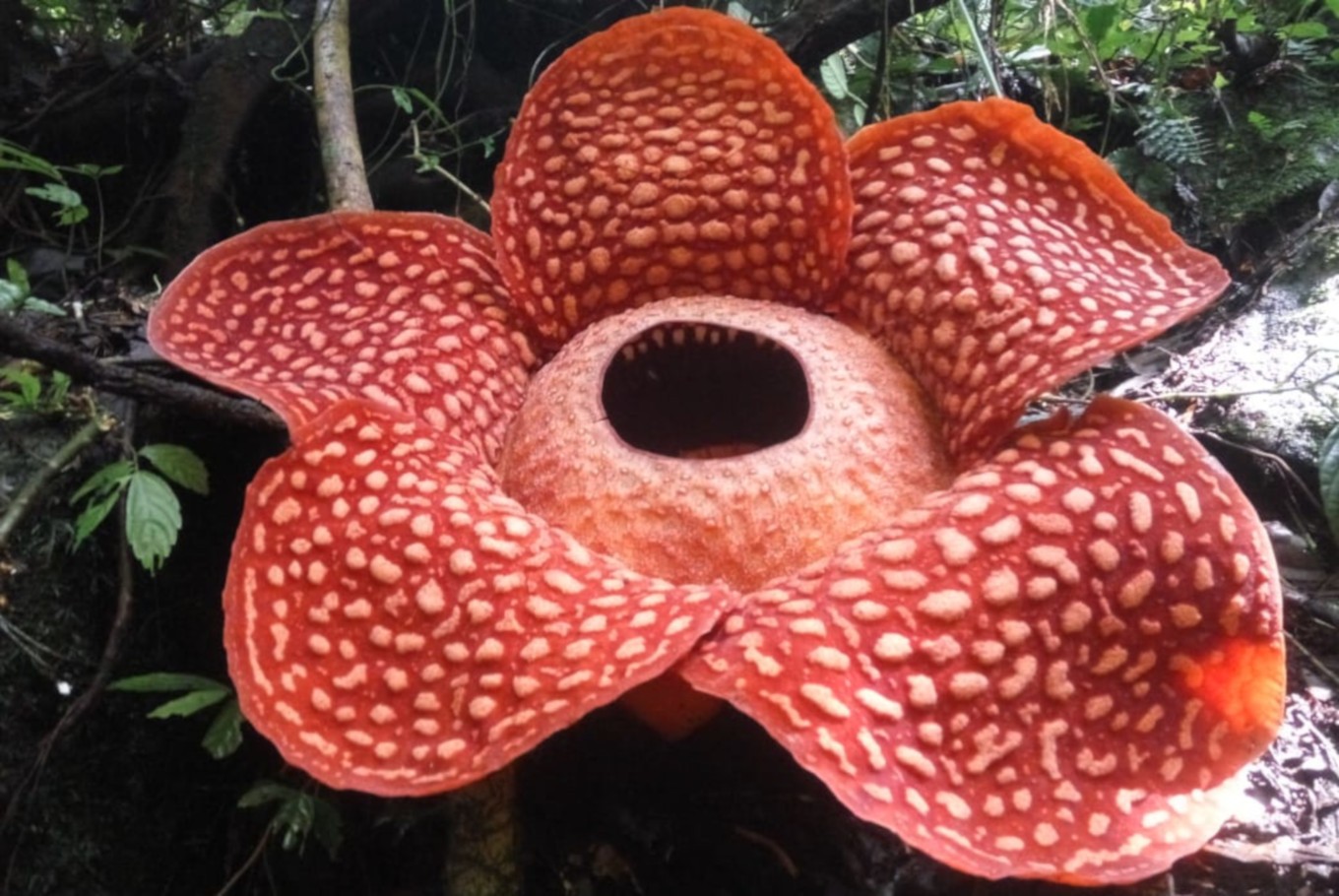
I was recently reading a January addition of New Scientist and it had a short article about the discovery of the largest flower ever recorded. Having completed a degree in biology, I am somewhat familiar with Rafflesia, as it crops up in many modules from biodiversity to chemical communication. However, my friend leaned over and exclaimed, ‘what an UGLY flower!’ They were even less impressed when they found out that colloquially Rafflesia is known as the ‘corpse lily’. Now, I do agree that Rafflesia is not the most beautiful flower: it’s fleshy, bulbous, and lumpy, however, it is a very interesting flower.
When I say flower, the most common examples to pop to mind will be from leafy green plants. You’ll probably picture daisies or roses or lilies. A parasite is unlikely to pop to mind. However, that is exactly what Rafflesia is – a parasitic flowering plant. Rafflesia plants are total heterotrophs – they cannot produce their own food. Most plants are autotrophs – they can generate their own ‘food’ through photosynthesis. Rafflesia is a plant, but it does not photosynthesise. It has no roots, no leaves, not even a stem – it exists for most of its life as hair-like filaments within a host plant, generally some sort of vine. However, occasionally they will produce the huge flowers that make them so famous. Why? Because even parasites need to reproduce.
The Rafflesia needs its pollen to be transferred to another individual, allowing the fusion of gametes and therefore a new, genetically unique generation to be produced. We are very familiar with flowers and how they spread their pollen far and wide. Most famously, bees are widely known as important pollinators, which they most certainly are, however, flies (diptera), one of the most hated animal orders on the planet (mainly associated with the spread of disease and filth) are extremely important pollinators! In the UK, adult flies are in the top 6 most important pollinators. Onions, carrots and parsley are all pollinated by flies. There would be no chocolate industry if it wasn’t for the chocolate midge! And there would be no Rafflesia is it wasn’t for carrion flies!
Carrion flies are attracted to dimethyl disulphide (DMDS) and DMTS dimethyl trisulphide (DMTS) both of which are foul smelling volatile chemicals. These chemicals are quite common – they are produced by bacteria when decomposing flesh, which is what attracts insects such as blowflies to dead animals. Rafflesia is a carrion flower and smells like rotting flesh, and therefore attracts carrion flies by mimicking the smell of rotting carcasses. The insects are attracted as they like to lay their eggs on rotting flesh (lots of juicy food for the larvae to dig into when hatched), so they fly to the Rafflesia and land on it, thereby picking up pollen as it gets stuck to their legs and torso, and hopefully then delivering it to other flowers in the vicinity.
But why so big? Carrion flowers are often very large, either to mimic the shape of large animal carcasses, or perhaps to produce larger quantities of scent. And that’s why Rafflesia is in the news – with an individual found in January measuring 1.1 meters in diameter!

Sources and further reading:
The original article: New Scientist, pg 12, 18 Jan 2020
Kew Information about Rafflesia: http://powo.science.kew.org/taxon/urn:lsid:ipni.org:names:316069-1
Watch an ecologist trek into the jungle to find Rafflesia! https://www.youtube.com/watch?v=0cGRujABwuQ
The science behind Rafflesia and carrion fly attraction: https://ukm.pure.elsevier.com/en/publications/pollinator-specialization-in-the-enigmatic-rafflesia-cantleyi-a-t
A super interesting article about the importance of flies: https://www.rsb.org.uk/get-involved/biology-for-all/158-biologist/features/2131-an-order-of-magnitude-2
Image: https://www.thejakartapost.com/life/2020/01/02/worlds-largest-rafflesia-tuan-mudae-blooms-in-west-sumatra.html (bksdasumbar.org/File)
My EndNote and Web of Knowledge account seems to be down hence why my sources and referencing is not as exhaustive as usual. Hopefully it will all be back up and running soon!
 Flora's Science Digest