I am a biology graduate of the University of Manchester. I find biology, and science in general, fascinating, and spend a lot of my time reading about new research and findings. This week I read Critical roles of regulatory B and T cells in helminth parasite-induced protected against airway inflammation by Gao et al, published in Clinical and Experimental Immunology, Dec 2019. This paper is just one of hundreds that discuss how parasites might affect allergies and autoimmune diseases by dampening down the immune system, and I will discuss other papers in the future, however today I am going to discuss just this paper.
Allergic asthma is when a person’s asthmatic symptoms are triggered by allergens from their environment, for example, pet dander. Allergic asthma is thought to be the most common form of asthma (1) , responsible for three out of every five cases of asthma in adults (2). We all know someone who has asthma, which can range from being very mild however can also be deadly serious.
When allergens from the air are inhaled by someone with allergic asthma, the allergic reaction is triggered when immune cells (the white blood cells that save our lives on a daily basis) recognise these allergens and react inappropriately, triggering inflammation of the airways (3). This inflammation causes the symptoms that leave sufferers reaching for an inhaler, coughing and wheezing. As asthma can be fatal, a lot of funding is put towards research into alleviating and treating these symptoms.
One line of study looks into how parasitic infections may help relieve asthma by dampening down the immune response. You might already be familiar with certain parasites. When I asked my mum what the first thing that came to mind about parasites was she said, “little creatures living under your skin”. She’s not wrong – some parasites do live under your skin, for example Onchocerca volvulus, that lives in the subcutaneous tissues directly under the skin . My dad just said, “tapeworm”, which is probably one of the most widely known parasites. Parasites can be defined as organisms that survive by living off another organism, to the detriment of the host. Parasitism is in fact the most successful form of life; there are more parasitic life forms than any other type of living organism (4). The type of parasite that has been floated as a form as therapy for allergic asthma is helminths.
Helminth are worms. They come in many shapes and sizes, from a few millimeters to several meters long! The word ‘helminth’ covers a huge range of parasitic worms from whipworm to roundworm to tapeworm (5). People can become infected by helminth parasitic infections through many different ways, however one of the most common is the fecal-oral route, i.e. when food or drink becomes contaminated with poo which contains the eggs of the parasite.
Helminth infection has been floated as an idea for the treatment of allergic asthma because people in areas of high helminth infection are unlikely to develop allergic asthma, and vice versa (6). A recent study by Gao et al. published online over the Summer of 2019 describes how regulatory B and T cells play an important role in this inverse correlation.
B and T cells are white blood cells that are part of the adaptive immune system – they are able to learn about certain pathogens and diseases and remember them. This memory means that if a person becomes re-infected with the same pathogen, the immune system is ready-prepped to fight it. Using mice as a model organism, the paper describes how T-regulatory and B-regulator cells – subsets of B and T cells that play an important regulatory role – reduce the inflammation of airways after stimulation from an allergen only when the immune system is simultaneously challenged by parasitic infection, the parasite in this case being the nematode Heligmosomoides polygyrus. The parasite-free mice had worse airway inflammation than the parasite-infected mice. This study contributes to the growing pile of evidence that parasites might be able to suppress inappropriate immune reactions. Who knows – maybe sometime in the future parasites or parasitic proteins will be used in the treatment of allergic asthma. This of course is a long way off, but it’s pretty amazing to think about!
However, it is important to note that a parasitic worm infection is not all song and dances: they cause horrible symptoms that people across the world suffer from. For example, whipworm infection causes growth stunting, malnutrition and iron deficiency (7), and tapeworm infection can cause anaemia and malnutrition (8). So don’t start self-treating just yet!!

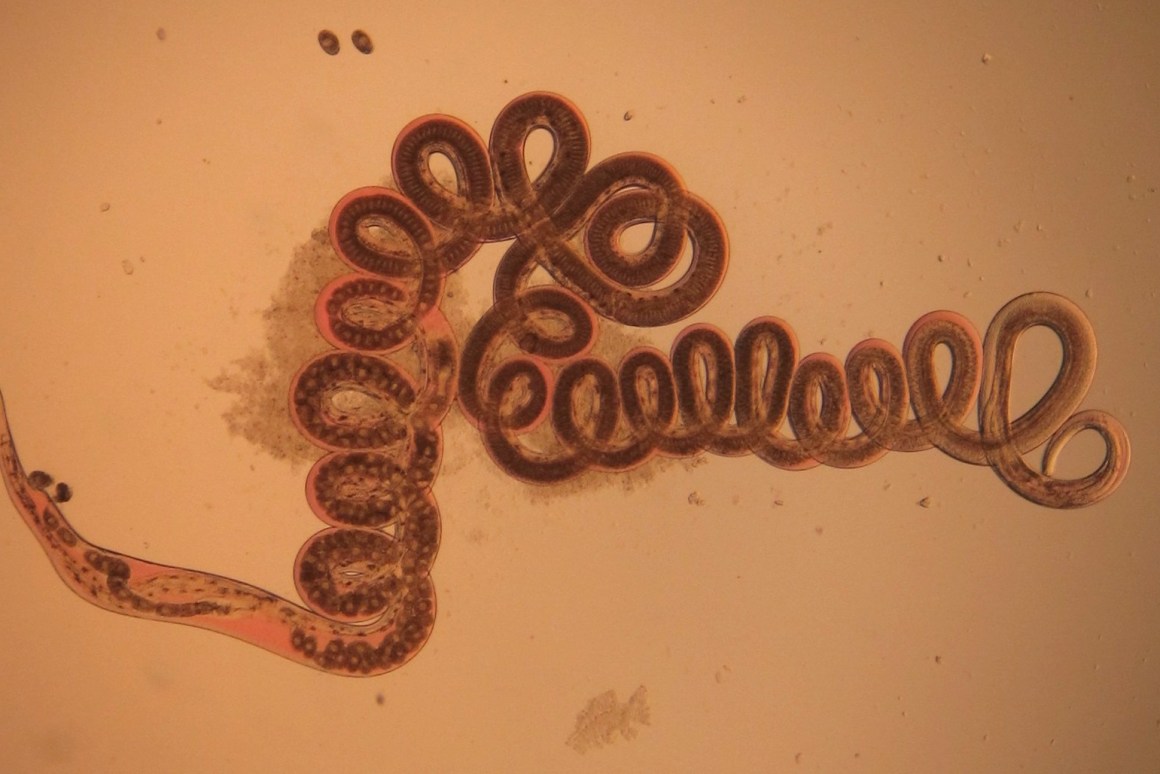
This is what Heligmosomoides polygyrus looks like. Image source: https://newatlas.com/parasite-worms-immune-anti-inflammatory-obesity/53939/ Read this for more information about how parasite infection could be beneficial to overall health.
References:
- M. H. Lafeuille, J. Gravel, M. Figliomeni, J. Zhang and P. Lefebvre, Burden of illness of patients with allergic asthma versus non-allergic asthma, Journal of Asthma 50 (2013), no. 8, 900-907.
- T. B. Knudsen, S. F. Thomsen, H. Nolte and V. Backer, A population-based clinical study of allergic and non-allergic asthma, Journal of Asthma 46 (2009), no. 1, 91-94.
- A. B. Mukherjee and Z. J. Zhang, Allergic asthma: Influence of genetic and environmental factors, Journal of Biological Chemistry 286 (2011), no. 38, 32883-32889.
- A. Dobson, K. D. Lafferty, A. M. Kuris, R. F. Hechinger and W. Jetz, Homage to linnaeus: How many parasites? How many hosts?, Proceedings of the National Academy of Sciences 105 (2008), no. Supplement 1, 11482-11489.
- Castro GA. Helminths: Structure, Classification, Growth, and Development. In: Baron S, editor. Medical Microbiology. 4th edition. Galveston (TX): University of Texas Medical Branch at Galveston; 1996. Chapter 86. Available from: https://www.ncbi.nlm.nih.gov/books/NBK8282/
- X. Gao, X. Ren, Q. Wang, Z. Yang, Y. Li, Z. Su and J. Li, Critical roles of regulatory b and t cells in helminth parasite-induced protection against allergic airway inflammation, Clinical and Experimental Immunology (2019), 13.
- King, I. L. & Li, Y. Host–Parasite Interactions Promote Disease Tolerance to Intestinal Helminth Infection. Frontiers in Immunology (2018), 9.
- Webb, C, Cabada, M. Intestinal Cestodes. Current Opinions in Infectious Diseases (2017),30.
Picture Reference: https://newatlas.com/parasite-worms-immune-anti-inflammatory-obesity/53939/
 Flora's Science Digest